Senior Travel Health Insurance: Medical Evacuation Costs, Coverage Limits, and Policy Rules
A detailed guide for older adults traveling abroad, covering Medicare international limitations, primary versus secondary policies, medical evacuation expenses, pre-existing condition waivers, and claim requirements.
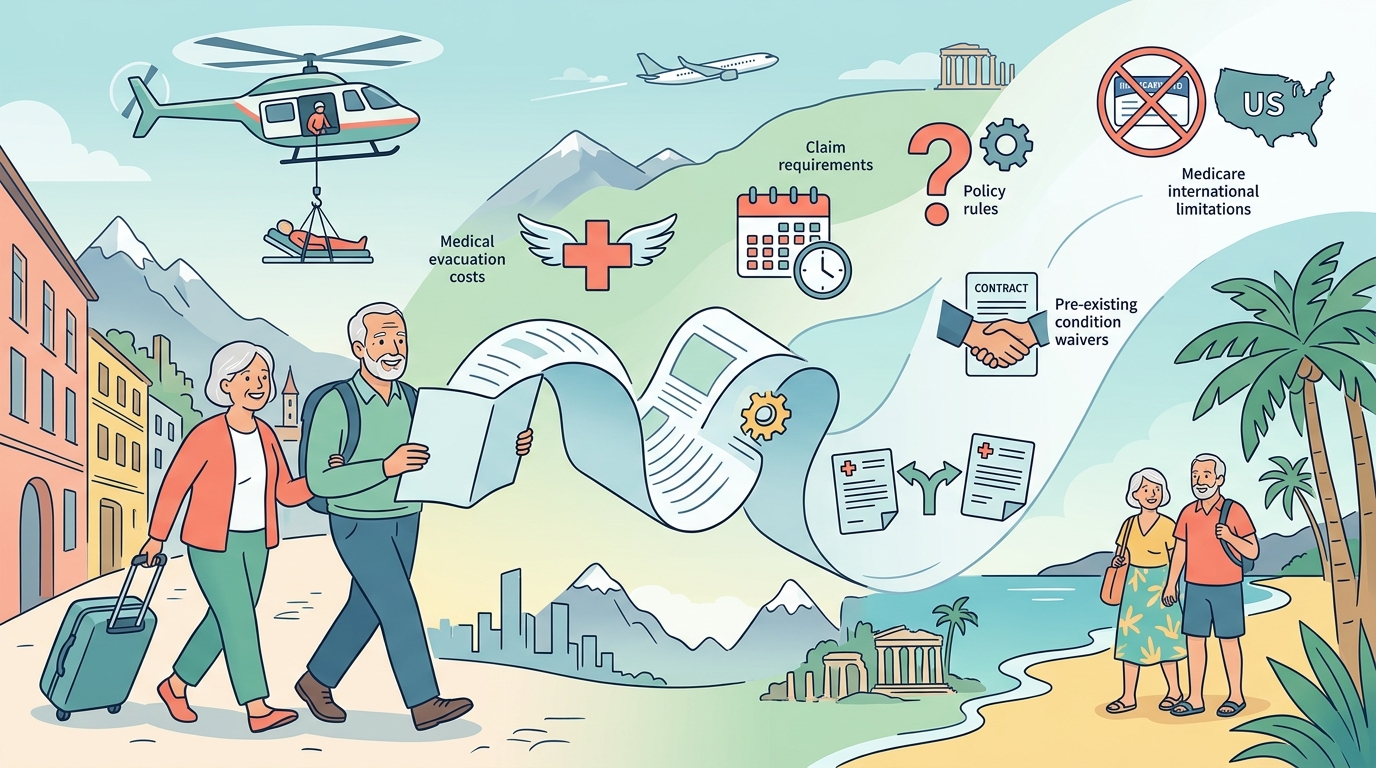
Traveling abroad in retirement offers unprecedented opportunities for exploration, but cross-border travel introduces distinct financial and medical risks for older adults. Standard domestic health insurance plans and Medicare generally offer little to no protection once a traveler leaves United States territory (Source 1). In the event of a sudden illness or severe injury overseas, medical care and emergency transportation back to the United States can generate catastrophic out-of-pocket expenses.
To mitigate these financial liabilities, older travelers frequently turn to senior international travel health insurance. These specialized policies are designed to cover urgent medical treatments, overseas hospital stays, and emergency medical evacuation. Understanding how these policies function—specifically regarding policy limits, primary versus secondary coverage, pre-existing condition waivers, and Medicare exclusions—is vital for securing adequate financial protection during foreign travel.
Medicare Coverage Limitations Outside the United States
A common misconception among older travelers is that Medicare provides continuous health coverage worldwide. Under federal guidelines, Original Medicare (Part A and Part B) generally does not cover healthcare services delivered outside the 50 United States, the District of Columbia, and U.S. territories such as Puerto Rico, Guam, the U.S. Virgin Islands, American Samoa, and the Northern Mariana Islands (Source 1).
Original Medicare includes very narrow statutory exceptions for foreign medical treatment. These exceptions typically apply only in limited scenarios:
- You experience a medical emergency while inside the United States, and the nearest foreign hospital qualified to treat your condition is closer than the nearest available U.S. hospital.
- You are traveling through Canada via a direct route between Alaska and another U.S. state, a medical emergency occurs, and a Canadian hospital is closer than the nearest U.S. hospital.
- You live in the United States and require non-emergency or emergency hospital care, and the foreign hospital is closer to your residence than any available domestic hospital.
- You suffer a covered injury or illness aboard a cruise ship situated within U.S. territorial waters (within 12 nautical miles of a U.S. port).
Outside of these precise situations, Original Medicare pays nothing for healthcare services received in foreign countries (Source 1). Supplemental insurance options, such as certain Medigap plans (specifically Plans C, D, F, G, M, and N), offer foreign travel emergency coverage as an added benefit. These Medigap plans typically cover 80% of billed expenses for emergency care received during the first 60 days of an international trip, subject to a standard $250 annual deductible and a lifetime maximum benefit of $50,000. For extensive travel or severe medical emergencies, a $50,000 lifetime cap may leave significant unpaid balances.
Medicare Advantage (Part C) plans may offer urgent or emergency care benefits outside the United States. However, individual network restrictions, deductible requirements, foreign reimbursement rules, and overall coverage limits vary substantially by plan provider. Consequently, public health entities advise all international travelers to evaluate specialized supplemental travel health insurance before departure (Source 1).
Primary vs. Secondary Travel Medical Insurance
When selecting a travel medical policy, senior travelers must distinguish between primary and secondary coverage structures. This distinction directly determines how claims are handled, who pays first during an emergency, and the amount of out-of-pocket friction a policyholder encounters at foreign medical facilities.
Primary travel medical insurance pays valid covered expenses from the first dollar, up to policy limits, without requiring the policyholder to file a claim with domestic insurance providers first. If an emergency hospital admission occurs overseas, a primary insurer communicates directly with the foreign medical facility to coordinate billing or process direct payment. This arrangement drastically reduces out-of-pocket cash burdens for the traveler.
Secondary travel medical insurance requires the traveler to exhaust all primary health coverage options before the secondary policy assumes financial responsibility. In practice, because Original Medicare does not cover overseas treatment, a Medicare enrollee with a secondary travel policy must first submit claims to Medicare, receive an official Explanation of Benefits (EOB) denial letter, and subsequently submit that denial to the secondary travel insurance provider. This multi-step administration process prolongs claim resolution and typically requires the senior traveler to pay foreign hospital bills out of pocket at the time of service.
| Coverage Feature | Primary Travel Medical Insurance | Secondary Travel Medical Insurance |
|---|---|---|
| First-Payer Responsibility | Pays covered claims immediately without domestic filing. | Requires filing with domestic health insurer first. |
| Out-of-Pocket Cash Required | Low to Moderate; often coordinates direct hospital billing. | High; traveler usually must pay initial hospital bills upfront. |
| Coordination with Medicare | Bypasses Medicare denial steps for direct processing. | Requires written claim denial from Medicare before paying. |
| Administrative Processing Time | Generally faster resolution due to direct claims structure. | Slower; dependent on receiving domestic primary EOBs. |
Emergency Medical Evacuation Threshold Costs and Repatriation
Medical evacuation coverage is distinct from basic emergency medical treatment. While standard emergency medical insurance pays for inpatient hospital stays, doctor fees, and medications, emergency medical evacuation covers specialized transportation to an appropriate medical facility or back to the home country when local healthcare infrastructure cannot adequately handle the patient's condition (Source 1).
The logistics of an international medical evacuation are complex and costly. If an individual suffers a major health event—such as a stroke, cardiovascular collapse, or severe trauma—in a remote location or an area with limited clinical capabilities, emergency transport requires dedicated medical transport services. These services range from commercial airline medical escorts to private air ambulances equipped with intensive care units and specialized medical crews.
According to typical emergency transport fee schedules and industry logistics data, international evacuation expenses vary based on geographic distance, aircraft requirements, and clinical complexity:
- Regional Evacuation (e.g., Caribbean or Central America to the U.S.): $25,000 to $50,000.
- Transatlantic Evacuation (e.g., Western Europe to U.S. East Coast): $75,000 to $120,000.
- Long-Haul Transpacific or Remote Evacuation (e.g., Southeast Asia, Africa, or cruise ships at sea to the U.S.): $150,000 to exceeding $250,000.
Repatriation of remains is an additional policy component that covers the logistical and regulatory costs of preparing and transporting a deceased traveler back to their home country. Insurers typically establish dedicated sub-limits for repatriation, often ranging from $20,000 to $50,000.
Insurance experts generally advise older travelers to secure a minimum of $100,000 in emergency medical coverage and $250,000 to $500,000 in emergency medical evacuation limits when traveling to remote areas or developing nations.
Qualifying for a Pre-Existing Condition Exclusion Waiver
By default, standard travel insurance plans exclude coverage for medical conditions that were active, diagnosed, or treated during a specified timeframe before the policy's effective date. This period is known as the "look-back period" and typically spans 60 to 180 days prior to purchasing the plan.
During the look-back period, an insurer reviews the applicant's medical history for any of the following triggers:
- New diagnoses or worsening symptoms of an existing medical condition.
- Changes in prescription medication dosages or recommendations for new medications (excluding routine dosage adjustments for stable conditions like thyroid management).
- Recommended diagnostic tests, pending lab results, or scheduled surgical procedures.
If a senior experiences a medical event overseas stemming from a condition flagged during the look-back period, the insurer can deny coverage under the pre-existing condition exclusion clause. However, travelers can void this exclusion by obtaining a Pre-Existing Condition Exclusion Waiver.
To qualify for a valid pre-existing condition waiver, travelers must satisfy strict strict operational criteria set by the insurance underwriter:
- Prompt Purchase Window: The policy must be purchased within a specified timeframe following the initial trip deposit—typically between 10 and 21 calendar days.
- Full Trip Cost Coverage: The insured must cover 100% of all prepaid, non-refundable travel arrangements (e.g., flights, cruise bookings, tour deposits).
- Medically Fit to Travel: The traveler must be medically stable and physically capable of traveling on the day the policy is purchased and paid for.
- U.S. Residency: The policyholder must be a legal resident of the United States and eligible for standard insurance plans.
Claim Documentation Requirements for Foreign Hospital Admissions
Filing an international travel health insurance claim requires strict attention to documentation. Foreign hospitals rarely operate on U.S. billing standards, and many foreign facilities demand immediate payment prior to patient discharge (Source 1).
When an emergency admission occurs, the traveler or their traveling companion must contact the insurance company's 24/7 assistance hotline immediately. The assistance team can issue a Guarantee of Payment (GOP) to the foreign hospital, which establishes direct billing between the facility and the insurer, avoiding large out-of-pocket charges on credit cards.
To ensure full reimbursement for out-of-pocket costs or covered emergency care, policyholders must secure comprehensive documentation from foreign healthcare providers prior to departure:
| Required Document | Purpose | Critical Details Needed |
|---|---|---|
| Itemized Medical Bills | Proves specific services provided. | Must list individual procedures, daily room charges, and medications. |
| Physician Clinical Notes | Establishes medical necessity and diagnosis. | Must detail onset of symptoms, admitting diagnosis, and medical history. |
| Proof of Payment | Verifies out-of-pocket expenses incurred. | Credit card statements, foreign currency receipts, or bank wire receipts. |
| Admission & Discharge Summaries | Confirms duration and outcome of care. | Exact dates, times, and discharge instructions from the facility. |
| Original Flight / Travel Itinerary | Validates trip dates and location. | Boarding passes, booking confirmations, or cruise manifests. |
In addition to clinical records, expenses paid in foreign currencies are converted to U.S. dollars using official exchange rates from the date of service. If records are written in a foreign language, the insurer may require certified translations, which can delay processing times.
Senior Travel Insurance Comparison Framework
Comparing international travel insurance plans requires older adults to look beyond base premiums. Premiums rise substantially with age, reflecting the increased statistical likelihood of medical claims. When evaluating plans, seniors should assess the following parameters:
- Age Caps and Tier Breaks: Many plans alter benefit caps or drastically increase premiums at key age thresholds, such as 65, 70, 75, and 80.
- Medical Limit Caps: Look for policies offering at least $50,000 to $100,000 in emergency medical coverage rather than baseline $10,000 caps.
- Deductible Structure: Select deductibles ($0 to $2,500) that balance upfront premium savings with accessible out-of-pocket limits during an emergency.
- 24/7 Assistance Capabilities: Confirm that the insurer maintains a dedicated international emergency support team capable of managing translation services, air ambulance dispatch, and direct hospital guarantees.
Practical Steps Before Departing Overseas
Before embarking on international travel, older adults should execute a targeted checklist to protect their health and financial security:
- Review CDC Health Notices: Consult the CDC Travelers' Health website to check destination-specific health risks, vaccine requirements, and safety advisories (Source 1).
- Verify Medicare and Medigap Coverage: Contact your Medicare Advantage plan or Medigap provider to confirm exact international emergency limits and out-of-country restrictions.
- Secure Travel Insurance Early: Purchase a comprehensive travel health policy within 10 to 21 days of paying your initial trip deposit to qualify for pre-existing condition waivers.
- Carry Physical Cards and Copies: Bring digital and physical copies of your domestic health cards, travel insurance policy documents, and 24/7 assistance emergency contact numbers.
- Register with STEP: Enroll in the Smart Traveler Enrollment Program (STEP) through the U.S. Department of State to receive safety updates and enable embassy assistance during crisis situations.
Does Medicare cover medical care while on a foreign cruise ship?
Original Medicare only covers emergency medical care on a cruise ship if the doctor is medically qualified and licensed to practice in the U.S., and the ship is located in a U.S. port or within 12 nautical miles of a U.S. port (Source 1). Once the ship passes beyond U.S. territorial waters or docks at a foreign port, Medicare coverage ceases.
What is the difference between travel medical insurance and trip cancellation insurance?
Trip cancellation insurance reimburses non-refundable prepaid trip costs (e.g., airfare, hotel deposits) if you must cancel your trip before departure due to a covered reason. Travel medical insurance pays for emergency healthcare services, hospital stays, and medical transportation incurred while you are traveling abroad.
Can I buy a travel medical insurance policy after I have already departed on my trip?
While a few specialized insurers offer post-departure travel medical insurance, most policies must be purchased before leaving your home country. Furthermore, pre-existing condition waivers strictly require purchasing the policy shortly after making your initial trip deposit, prior to departure.
Sources
- Travelers' Health — Centers for Disease Control and Prevention
This article is for general information only and is not professional advice. Figures come from public sources and change over time; check the official source before you act.
More from True Money Net
- Save Up to 50 Percent on Dental Implants at Local Schools
- See 5 Essential Rules to Qualify for Free Implants
- Find 5 Official Low Cost Dental Programs for Seniors Today
- 5 Hidden Rules to Get Dental Implants Covered by Insurance
- SSDI Spousal Benefits: Eligibility Rules, Payment Limits, and Calculations
- FHA 203(k) Home Rehabilitation Loans: Appraisal Guidelines, Eligible Upgrades, and Fee Structures