Total Loss Auto Insurance Claims: Actual Cash Value Disputes and Rights of Appeal
Learn how insurance companies calculate Actual Cash Value, how state total loss thresholds work, and how to use appraisal clauses and market data to challenge low settlement offers.
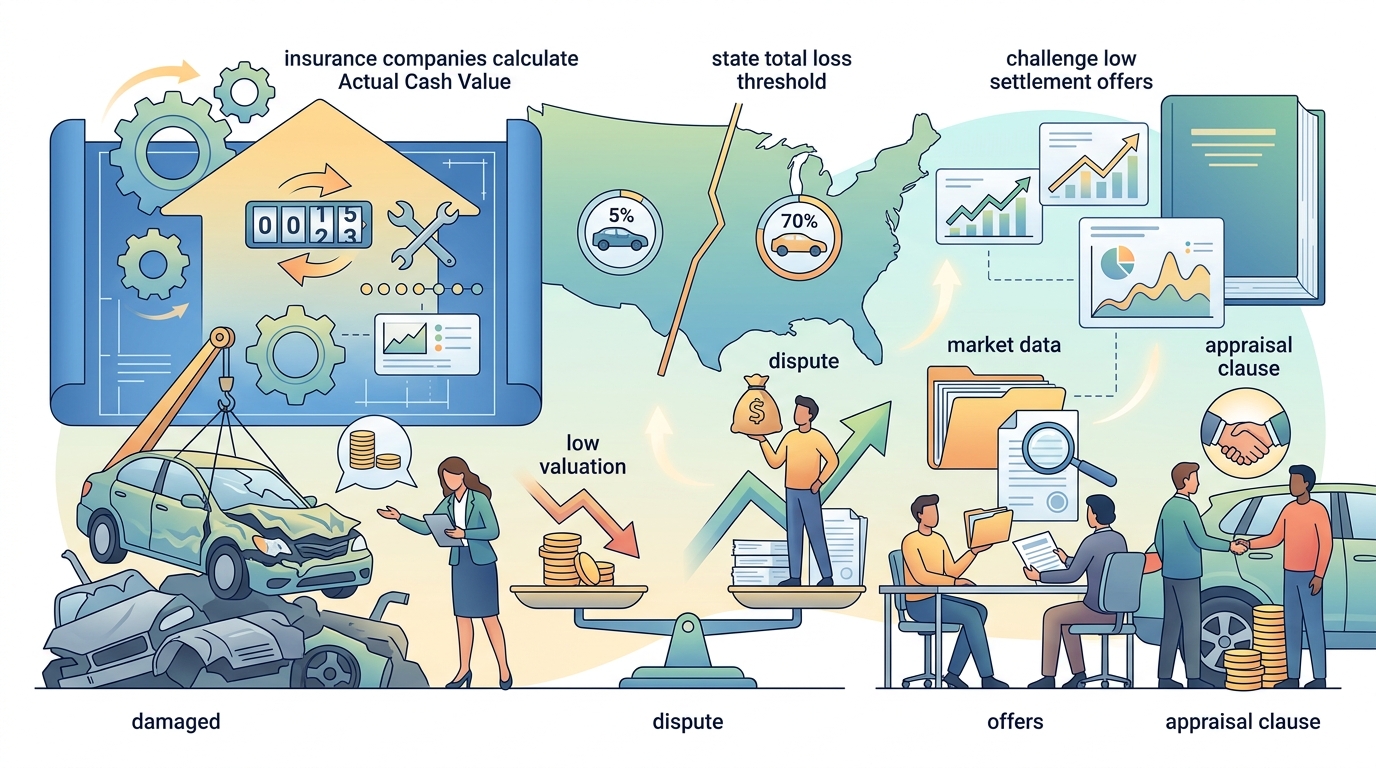
When an automobile is involved in a severe collision or sustains severe storm damage, an insurance provider conducts a loss adjustment evaluation to determine whether the vehicle can be safely and economically repaired. If the estimated cost of repairs exceeds specific statutory or policy limits, the insurer declares the vehicle a total loss. In a total loss auto insurance claim, the insurer does not pay the original purchase price or the amount required to buy a brand-new vehicle; instead, it pays the vehicle's Actual Cash Value (ACV) minus any applicable policy deductible (Source 1).
Navigating a totaled car settlement payout can be challenging for policyholders who discover that the insurer's initial offer is lower than local market prices for equivalent vehicles. Understanding how insurers calculate valuation, recognizing state-mandated total loss thresholds, and knowing how to invoke contractual rights like the appraisal clause are essential consumer protection steps. Consumer resources from agencies like the Consumer Financial Protection Bureau emphasize the importance of reviewing all documentation provided by financial institutions and insurers during dispute processes (Source 1).
How Insurance Companies Calculate Actual Cash Value (ACV)
Actual Cash Value auto insurance terminology defines ACV as the fair market value of the vehicle immediately before the loss occurred. This amount reflects depreciation, mileage, physical condition, optional equipment, and local market trends. ACV is distinct from replacement cost, which would cover the price of purchasing a new vehicle of the current model year.
To establish an ACV, most insurance carriers do not rely on standard consumer valuation tools like Kelley Blue Book or Edmunds. Instead, they license specialized software databases generated by third-party vendor companies such as CCC Intelligent Solutions (CCC ONE), Mitchell International, or Audatex. These vendors run automated algorithms that aggregate recent dealer sales, wholesale database listings, and regional private market transactions to produce a customized valuation report.
- Base Vehicle Specification: The software pulls data based on the specific Vehicle Identification Number (VIN), including factory options, engine size, and trim level.
- Condition Adjustments: Adjusters rate vehicle components (paint, bodywork, interior, tires, and mechanical condition) as exceptional, good, average, or poor, applying financial deductions for existing wear.
- Local Comparable Market Search: The system identifies recently sold or listed vehicles of similar make, model, year, and mileage within a specified geographic radius (typically 50 to 150 miles).
- Condition and Equipment Normalization: The software adjusts the prices of comparable vehicles upward or downward to account for differences in mileage, options, and overall state compared to the loss vehicle.
Understanding State Total Loss Thresholds: Percentage vs. Total Loss Formula
State insurance regulations dictate when an insurance company must declare a vehicle a total loss rather than authorizing repairs. States generally utilize one of two legal standards to establish this determination: a statutory Percentage Threshold or the Total Loss Formula (TLF).
In Percentage Threshold states, state law dictates that if the cost of repairs equals or exceeds a specific percentage of the vehicle's pre-accident ACV, the car must be declared a total loss. This threshold varies significantly across jurisdictions, ranging from 60% in some states to 100% in others. For example, if a vehicle has an ACV of $10,000 and the state threshold is 75%, an estimated repair bill of $7,500 or higher automatically mandates a total loss designation.
In Total Loss Formula states, there is no fixed statutory percentage. Instead, the insurer applies a mathematical calculation: Cost of Repair + Salvage Value >= Actual Cash Value. The salvage value represents the projected amount a commercial salvage yard would pay for the damaged vehicle at auction. If the combined sum of the repair estimates and the scrap valuation equals or exceeds the vehicle's pre-accident ACV, the insurer must total the vehicle.
| State Model | Mechanism / Formula | Practical Calculation Example | Impact on Dispute Strategy |
|---|---|---|---|
| Percentage Threshold | Mandatory total loss when repair costs reach a fixed percentage of ACV (e.g., 70% to 80%). | ACV = $15,000. Threshold = 75% ($11,250). Repair estimate = $11,500. Result: Total Loss. | Increasing the ACV estimate can raise the dollar cap, potentially allowing a vehicle to be repaired. |
| Total Loss Formula (TLF) | Total loss declared if Repair Cost + Salvage Value exceeds or equals ACV. | ACV = $15,000. Repair = $11,000. Salvage Value = $4,500. Sum ($15,500) > $15,000. Result: Total Loss. | Disputes can focus on both the accuracy of the ACV and the fairness of the salvage bid. |
Requesting and Reviewing the Insurer's Valuation Report
When an adjuster verbally presents a totaled car settlement payout, policyholders have the right to request a complete copy of the underlying valuation report. This document, often 10 to 20 pages in length, outlines every data point, math modifier, and comparable vehicle used to generate the offer. Reviewing this document line by line is a critical consumer protection measure, as automated valuation reports frequently contain factual inaccuracies (Source 1).
- Vehicle Trim and Options: Verify that the report accurately lists your vehicle's exact trim level (e.g., EX-L vs. LX) and factory-installed packages (such as leather seating, navigation, premium audio, or advanced driver assistance systems).
- Mileage Verification: Ensure the odometer reading captured on the report matches the actual mileage at the time of the crash. An overstated mileage figure artificially depresses ACV.
- Condition Rating Assessment: Examine the adjuster's ratings for interior, exterior, and mechanical components. Insurers frequently default components to 'average' or 'below average' without documented physical evidence of pre-existing damage.
- Comparable Vehicle Relevance: Review the 'comps' listed in the report. Ensure they represent active market listings or verified sales in your immediate geographic area, rather than distant markets with lower average vehicle pricing.
- Condition Adjustments on Comps: Check the monetary adjustments applied to comparable vehicles. Reports sometimes apply aggressive downward adjustments to dealer listings to lower the calculated average.
Negotiating Vehicle Total Loss Valuation: Gathering Comparable Market Data
Negotiating vehicle total loss valuation requires presenting documented market evidence rather than subjective arguments. If an insurer's settlement offer is lower than the local market cost to acquire an equivalent vehicle, policyholders can compile an independent market evaluation packet to submit to the claims adjuster.
To build an effective counter-argument, gather between three and five comparable vehicle listings from local dealerships, certified pre-owned networks, and reputable online auto sales platforms within a 50-mile to 100-mile radius. The comparable vehicles should match your totaled vehicle in year, make, trim level, engine type, and general mileage range.
- Gather Active Dealer Listings: Collect screenshots and vehicle details showing listing prices, VINs, and dealer locations for matching cars currently for sale.
- Document Recent Maintenance and Upgrades: Compile receipts for recently installed major components, such as new tires, fresh brakes, or major mechanical overhauls completed within the prior 6 to 12 months. While routine maintenance does not add dollar-for-dollar value, major capital improvements can raise the condition score.
- Identify Inaccuracies in Insurer Comps: If the insurer used comparable vehicles with branded titles, structural damage histories, or higher mileage, submit vehicle history reports demonstrating those flaws to disqualify them.
- Submit a Written Counter-Offer: Send a concise written letter summarizing the errors found in the initial valuation report, attached with your local market comps and an itemized adjustment request.
Using Independent Appraisal Clauses to Challenge Low Valuations
When direct negotiation with a claims adjuster fails to yield a fair settlement, policyholders can review their insurance policy contract for an Appraisal Clause auto insurance provision. Most standard personal auto policies include this dispute resolution clause, which provides a binding alternative to litigation.
The appraisal process allows both parties to hire independent professional vehicle appraisers to determine the pre-accident Actual Cash Value. The steps generally proceed as follows:
- Formal Written Demand: The policyholder sends a formal written request invoking the appraisal clause as specified in the insurance policy contract.
- Hiring Independent Appraisers: Both the policyholder and the insurance company select and pay for their own independent, qualified appraiser within a specified timeframe (typically 15 to 30 days).
- Appraiser Evaluation: The two independent appraisers review vehicle records, inspect physical or photographic evidence, evaluate regional market data, and attempt to reach an agreed-upon ACV.
- Selection of an Umpire: Prior to beginning evaluations, the two appraisers jointly select a neutral third-party umpire. If the two appraisers cannot agree on an ACV, they submit their differing reports to the umpire.
- Binding Determination: Agreement by any two of the three parties (the two appraisers and the umpire) sets the final, legally binding ACV settlement amount.
Policyholders must consider the cost-benefit ratio before invoking the appraisal clause. Hiring an independent automotive appraiser typically costs between $300 and $700, and umpire fees are usually split equally between the insurer and policyholder. If the expected increase in the settlement payout significantly exceeds these anticipated out-of-pocket appraisal fees, invoking the clause is a practical path to recovery.
Tax Credit, Title, and Registration Fee Reimbursement Rules
A frequently overlooked aspect of a total loss settlement payout is the legal entitlement to sales tax, vehicle registration, and title fee reimbursements. When a vehicle is totaled, replacing it requires paying mandatory government taxes and licensing fees to resume driving.
State laws regarding sales tax reimbursement vary across jurisdictions. Generally, state rules fall into two main categories:
- Mandatory Upfront Sales Tax Payment: In many states, insurance regulations require the insurer to include state and local sales tax in the initial total loss settlement calculation, regardless of whether the policyholder purchases a replacement vehicle immediately.
- Incurred-Cost Sales Tax Reimbursement: In other states, insurers are only required to reimburse sales tax after the policyholder purchases a replacement vehicle and provides proof of purchase within a specific timeframe (such as 30, 60, or 90 days from the settlement date).
- Transfer of Title and Registration Fees: Most state insurance regulations mandate that insurers reimburse policyholders for mandatory transfer fees, license plate transfer costs, and title documentation fees required to register a replacement car.
| Settlement Component | How Amount Is Calculated | Inclusion Rule / Standard |
|---|---|---|
| Base Vehicle Actual Cash Value (ACV) | Determined by valuation databases, market comps, and condition ratings. | Mandatory base component of all total loss payouts. |
| State & Local Sales Tax | Calculated as a percentage of the final agreed ACV (e.g., 6% to 9% depending on location). | Mandatory upfront or post-purchase reimbursement depending on state rules. |
| Title & Registration Fees | Fixed administrative costs charged by the state Department of Motor Vehicles. | Standard reimbursement item in most regulatory jurisdictions. |
| Policy Deductible | Subtracted from the total settlement if claiming under comprehensive or collision coverage. | Deducted upfront; recoverable via subrogation if an at-fault third party caused the crash. |
What happens if I owe more on my auto loan than the Actual Cash Value settlement?
If your loan balance exceeds the vehicle's ACV payout, you remain legally responsible for paying the remaining balance to your lender. Guaranteed Asset Protection (GAP) insurance, if purchased prior to the accident, is designed to pay the difference between the ACV settlement and your remaining loan balance (Source 1).
Can I keep my totaled vehicle after a settlement is agreed upon?
Yes, in most states policyholders can retain a totaled vehicle through a process called owner-retention. The insurer will subtract the vehicle's estimated salvage value from the final settlement payout, and the state DMV will issue a salvage or rebuilt title for the vehicle.
Is the initial total loss offer from an insurance company non-negotiable?
No. The initial settlement offer is a proposal based on automated database estimates. Policyholders have the legal right to inspect the report, identify factual errors, submit local market comparable data, or invoke the policy's independent appraisal clause to negotiate a higher valuation (Source 1).
Sources
- Consumer Financial Protection Knowledge Base — Consumer Financial Protection Bureau
This article is for general information only and is not professional advice. Figures come from public sources and change over time; check the official source before you act.
More from True Money Net
- Save Up to 50 Percent on Dental Implants at Local Schools
- See 5 Essential Rules to Qualify for Free Implants
- Find 5 Official Low Cost Dental Programs for Seniors Today
- 5 Hidden Rules to Get Dental Implants Covered by Insurance
- SSDI Spousal Benefits: Eligibility Rules, Payment Limits, and Calculations
- FHA 203(k) Home Rehabilitation Loans: Appraisal Guidelines, Eligible Upgrades, and Fee Structures