Save Up to 50 Percent on Dental Implants at Local Schools
Learn how accredited dental school clinics and federal health programs reduce out-of-pocket costs for dental implants through supervised resident treatment.
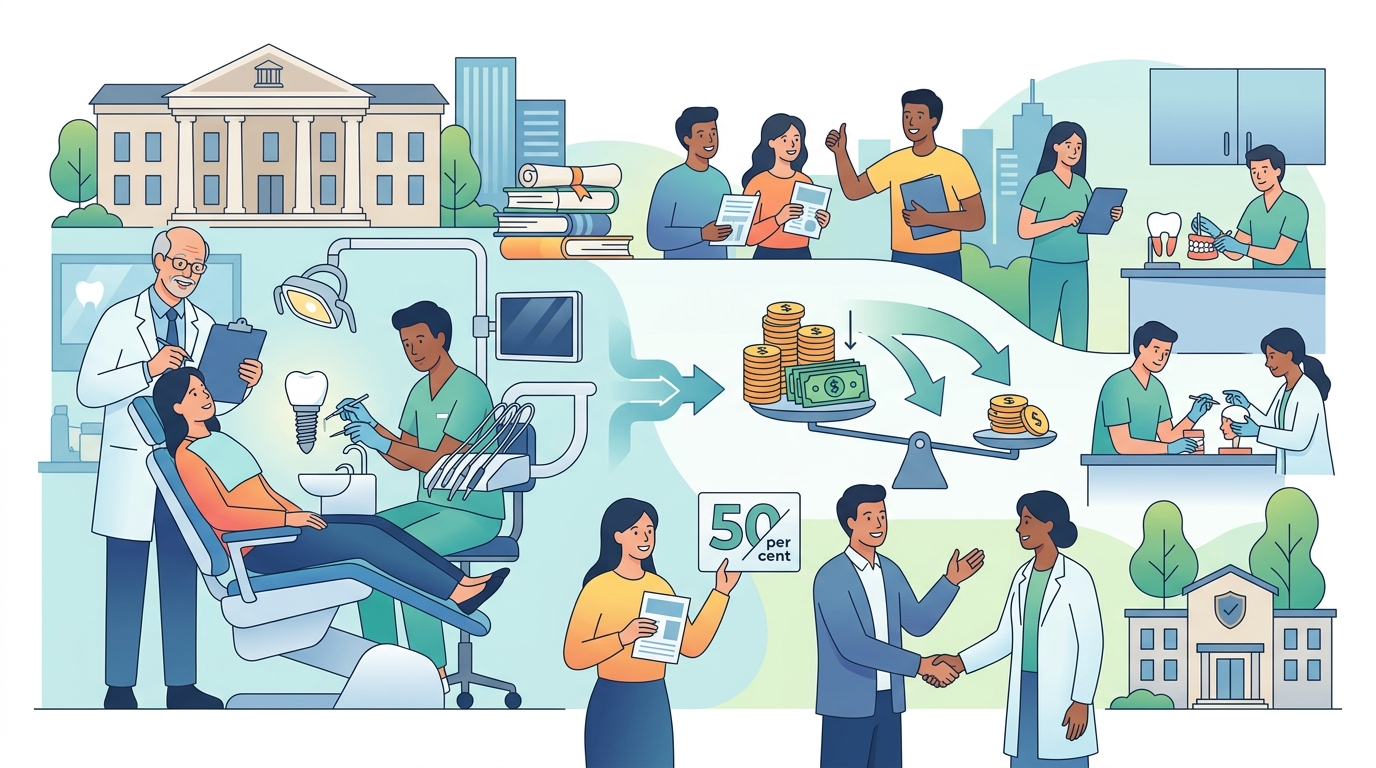
Dental implants can cost thousands of dollars per tooth in private practice settings, but visiting an accredited dental school clinic can reduce these out-of-pocket expenses substantially (Source 1). By allowing dental students and surgical residents to perform procedures under direct faculty supervision, educational institutions offer major discounts on complex dental care (Source 2).
Why Dental School Clinics Offer Substantial Fee Reductions
The primary reason dental schools offer low-cost services is their educational mission. Dental schools operate clinics to provide hands-on clinical experience for their students and specialty residents (Source 2). Because the clinic functions as a teaching facility rather than a profit-driven private practice, overhead costs are structured differently, allowing schools to pass savings directly to patients (Source 1).
In a typical teaching clinic setting, procedure fees are often 30% to 50% lower than standard regional private practice rates (Source 1). Patients pay reduced fees in exchange for spending extra time at the facility. Because faculty members review every step of the examination, diagnostic planning, and surgical execution, appointments take significantly longer than standard office visits (Source 2).
The price reduction applies not only to the implant post itself, but often extends to related procedures such as diagnostic imaging, preliminary tooth extractions, bone grafting, and final crown placement (Source 1). However, final costs vary depending on individual patient needs, local institution fee schedules, and the specific clinical department performing the work (Source 2).
Understanding Accreditation: The Role of CODA
Before scheduling an evaluation at any educational facility, patients should verify that the program is fully accredited. The Commission on Dental Accreditation (CODA) is the official accrediting body recognized by the U.S. Department of Education for dental education programs (Source 3). CODA standards ensure that the school adheres to strict national guidelines for clinical quality, infection control, and educational rigor (Source 3).
Receiving care at a CODA-accredited program ensures that all procedures are overseen by licensed dentist faculty members (Source 3). These faculty members are often experienced specialists, board-certified clinicians, or academic researchers who monitor every phase of patient treatment (Source 2).
- Verification of institutional accreditation status through official CODA listings (Source 3).
- Direct supervision by licensed faculty members during all clinical procedures (Source 2).
- Adherence to national standards for clinical safety and sanitary protocols (Source 3).
- Comprehensive diagnostic reviews before any surgical procedure commences (Source 1).
Predoctoral Clinics vs Postgraduate Specialty Clinics
Dental schools operate two distinct types of clinics: predoctoral clinics and postgraduate (resident) specialty clinics (Source 2). Understanding the difference between these two clinic types helps patients choose the right setting for their specific dental needs.
Predoctoral clinics are staffed by dental students completing their Doctor of Dental Surgery (DDS) or Doctor of Dental Medicine (DMD) degrees under faculty supervision (Source 2). These clinics handle general dentistry procedures and straightforward routine care. Fees in predoctoral clinics are generally the lowest available within the university system (Source 1).
Postgraduate clinics are staffed by licensed dentists who are undergoing advanced specialty training in fields such as prosthodontics, periodontics, or oral and maxillofacial surgery (Source 2). Because implant placement involves surgical precision and complex reconstruction, many dental schools assign implant cases to these postgraduate specialty clinics. Fees in resident clinics are slightly higher than in predoctoral clinics but remain well below commercial private practice rates (Source 1).
Comparing Low-Cost Dental Care Options
Patients seeking discounted dental implants or structural restorations have multiple institutional options. The table below outlines key differences between educational facilities, community health centers, and private practices.
| Facility Type | Typical Fee Savings | Primary Provider | Supervision Level |
|---|---|---|---|
| Dental School (Predoctoral Clinic) | 30% to 50% below private rates | Senior Dental Student | Continuous direct faculty oversight (Source 1, 2) |
| Dental School (Postgraduate Clinic) | 20% to 40% below private rates | Licensed Resident Specialist | Direct specialist faculty supervision (Source 2) |
| FQHC Community Health Center | Sliding scale based on income | Staff Dentist / Generalist | Independent licensed care (Source 5) |
| Private Dental Practice | Standard market rate | Private Practitioner | Independent licensed care |
The Patient Screening and Intake Process
Dental schools do not automatically accept every individual who applies for treatment. Because clinics exist primarily for educational purposes, patient selection depends on whether an individual's specific case aligns with the current training needs of the students or residents (Source 2).
The process begins with an initial screening appointment. During this visit, clinical staff take diagnostic X-rays, evaluate oral bone density, review medical histories, and determine whether the patient is a candidate for dental implants (Source 1). If a case presents unusual clinical complications, it may be directed to a specialty resident clinic or determined to be outside the scope of student training (Source 2).
Patients must also commit to a longer timeline. Appointments at dental schools typically take two to three hours per session because faculty members inspect and approve each phase of the procedure before the student can proceed (Source 1). Multiple appointments are usually required to complete initial diagnostics, surgical placement, osseointegration monitoring, and final abutment and crown installation.
Alternative Low-Cost Options: FQHCs and Clinical Trials
If a local dental school is not accessible, patients can explore other federally supported options for reduced-cost dental care. Community health centers funded by the Health Resources and Services Administration (HRSA) offer primary dental care services on a sliding-fee scale based on household income (Source 5). These Federally Qualified Health Centers (FQHCs) provide accessible care to low-income individuals and underinsured populations (Source 5).
While many community health centers focus primarily on preventive and basic restorative care rather than complex implant surgery, some larger FQHC networks partner with hospital programs or specialty residency programs to offer expanded surgical services (Source 5).
Additionally, the National Institute of Dental and Craniofacial Research (NIDCR) occasionally conducts clinical research studies that offer free or low-cost treatment for specific dental conditions (Source 4). Research studies recruit participants who meet precise clinical criteria for ongoing research trials (Source 4).
How to Find and Contact an Accredited Clinic
Finding a nearby dental school clinic requires consulting official educational directories. The American Dental Education Association (ADEA) maintains a complete directory of accredited dental schools across North America (Source 2).
- Visit the ADEA official website to view the regional map of accredited dental schools (Source 2).
- Contact the institution's patient admissions office to inquire about candidate screening (Source 2).
- Use the HRSA health center locator tool to find local community health clinics (Source 5).
- Check NIDCR clinical trials listings for open research studies on dental implants and restoration (Source 4).
When calling a dental school clinic, ask specifically for the patient intake coordinator and inquire about screening availability, estimated wait times for new patient evaluations, and typical fee schedules for implant consultations (Source 1).
Are dental implants at dental schools safe?
Yes. Care is provided by dental students or surgical residents under the direct, step-by-step supervision of licensed faculty dentists and specialists in CODA-accredited institutions (Source 2, 3).
How much can I save on dental implants at a dental school?
Patients typically save between 30% and 50% compared to standard private practice fees, though exact savings depend on the institution and procedural complexity (Source 1).
How do I sign up to become a patient at a dental school?
Contact the patient admissions office of a dental school listed in the ADEA directory to schedule an initial screening and diagnostic evaluation (Source 1, 2).
Sources
- Finding Low-Cost Dental Care — National Institute of Dental and Craniofacial Research
- American Dental Education Association — American Dental Education Association
- Commission on Dental Accreditation — American Dental Association
- National Institute of Dental and Craniofacial Research — National Institutes of Health
- Find a Health Center — Health Resources and Services Administration
This article is for general information only and is not professional advice. Figures come from public sources and change over time; check the official source before you act.
More from True Money Net
- Save Up to 50 Percent on Dental Implants at Local Schools
- See 5 Essential Rules to Qualify for Free Implants
- Find 5 Official Low Cost Dental Programs for Seniors Today
- 5 Hidden Rules to Get Dental Implants Covered by Insurance
- SSDI Spousal Benefits: Eligibility Rules, Payment Limits, and Calculations
- FHA 203(k) Home Rehabilitation Loans: Appraisal Guidelines, Eligible Upgrades, and Fee Structures